

Teachers make hundreds of decisions every day – often with limited time and incomplete information. Which learners need support? Who is ready for a challenge? Where are the unseen gaps? Adaptive Learn brings clarity to these questions. Designed for Cambridge Primary and Cambridge Lower Secondary, it is an adaptive digital resource that adapts to every pupil and turns learning data into insights educators can use immediately, ensuring that teaching decisions are informed, not guessed.
Identifying learning gaps early
One of the challenges in classrooms is catching learning gaps before they widen. Traditional assessments often rely on teachers to piece together evidence from classwork, homework and observation to reveal learners’ progress, needs and challenges faced. Adaptive Learn removes that delay. Through adaptive practice and realtime reporting, teachers see instantly where each learner is secure, where misconceptions are forming, and where additional support is needed.
“Through adaptive practice and real-time reporting, teachers see instantly where each learner is secure, where misconceptions are forming, and where additional support is needed.”
As a Cambridge partner with a deep understanding of the needs of Cambridge schools worldwide, Hachette Learning has mapped the Adaptive Learn materials to their Learner Books, which have been endorsed for the Cambridge Pathway. This means that you can use these resources alongside physical books, or can stand alone as independent practice for learners. Either way, they will fully support your Cambridge curriculum.
Personalising learning at scale
Even when teachers know exactly where learners are struggling, creating truly differentiated pathways for every child can be overwhelming. Adaptive Learn removes this workload by automatically adapting to each learner’s responses, pace and level of confidence. As pupils work through personalised sequences of questions, the resource adjusts in real time –providing stretch where learners are secure and support where they need it most.
“Adaptive Learn was highly impactful in enhancing our teaching and learning approaches. This platform has been invaluable in supporting teachers while actively engaging students in their learning.” – Ms Acera-Ducoyan, Bangkok Bilingual School, Thailand
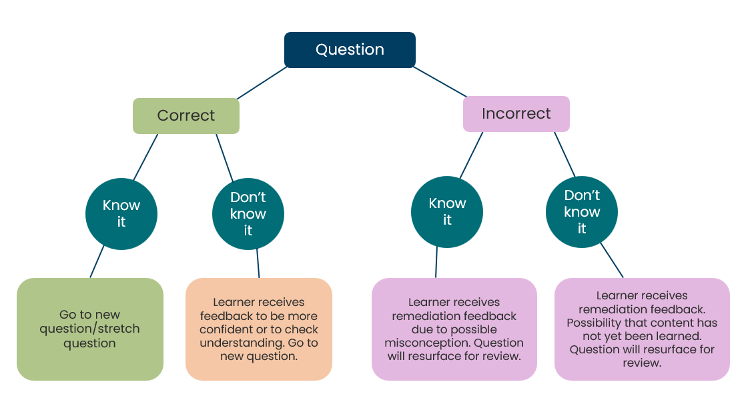
When a learner answers a question correctly or incorrectly, the system determines whether to provide stretch or additional support. In addition to this, learners are prompted to rate their confidence level (Know it, Think I know it, Not sure, or Don’t know it) – this measures learner metacognition and indicates to the system whether the learner has guessed the answer, has a misconception, or isn’t confident in their answer (despite getting it right). These two inputs (answer and metacognition), plus time taken, are what prompts new questions to be generated according to the learner’s need. Much like a personal tutor, Adaptive Learn tailors content to the individual learner and provides instant feedback. No two students will take the same learning path.
But all of this isn’t happening in a vacuum. Teachers can keep up with learners’ homework status in the Reports dashboard. Here, they will also see the learning objectives that learners are struggling with most to help plan their lessons. Metacognition data is also available here, so teachers can see on an individual and class level, what proportion of learners were aware that they knew the right answer and what proportion weren’t. For more information on metacognition, read this brilliant article by Anoara Mughal, metacognition specialist.
Making evidence-based decisions
Hachette Learning partnered with a number of schools who trialed Adaptive Learn through the early phases of development, giving feedback on what they liked and didn’t like, and took time to understand customers and worked closely with educators, learners, academics, awarding bodies and partners to develop Adaptive Learn. It is evidence based, and founded on research with real schools, teachers and learners’ needs and aspirations.
“Our teachers are really happy compared to other resources we’ve used before, because of the Cambridge focus… there’s nothing else like this that focusses as much on our curriculum.” – Ms Celiberti, St Constantine’s School, Tanzania
Adaptive Learn delivers content as unique as your learners, combining personalised digital practice with actionable insights for educators.
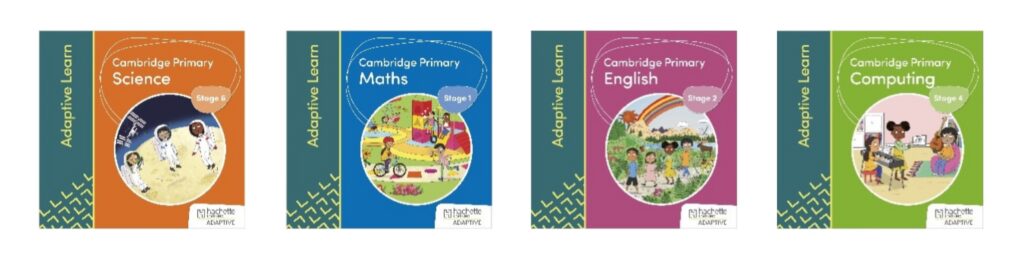
All of the features and benefits above can now be accessed by schools for our Cambridge Primary courses: Computing, English, Maths and Science courses, and more, stages 1 to 6.
Building a full picture of learners’ wellbeing
Learner wellbeing is essential for academic success, yet it can be difficult to measure meaningfully. Without clear insights, schools risk implementing generic strategies that fail to address the real issues learners face.
Adaptive Learn includes two types of wellbeing questionnaire, weekly ‘Check-ins’ and termly ‘Snapshots’. Wellbeing check-ins are for quick ‘temperature’ gauges on whether learners are ready to learn on any given day, and to encourage learners to think about their wellbeing on a regular basis. Wellbeing snapshots more detailed surveys which look at all aspects of learner wellbeing (social, academic, physical and emotional) on a termly basis, helping schools identify patterns over time.
Without clear insights, schools risk implementing generic [wellbeing] strategies that fail to address the real issues learners face.”
Adaptive Learn is built on a secure platform that adheres to strict data protection standards. Learners access it only through their school login, and the environment contains no public chat or unsafe content.
The resource is designed for focused, short bursts of learning, not prolonged screen time, and we encourage schools to balance digital learning with physical textbooks and manipulatives. Hachette Learning provides Teacher’s Guides, Learner’s Books and Workbooks that complement all of Adaptive Learn courses.
And what’s next?
Adaptive Learn will be launching for Lower Secondary (stages 7, 8 and 9) in April 2026, with further features and subject already in development.
Discover Adaptive Learn visiting Hachette Learning here.
By Hamish Baxter

Hamish Baxter is the Senior Lead Product Manager at Hachette Learning
