
For decades, education has been treated as a slow-moving institution, proudly traditional, structurally rigid and largely insulated from the turbulence shaping the world beyond the classroom. But today, as our planet barrels toward intertwined environmental, social and geopolitical crises, that rigidity is not harmless. It is dangerous.
Across the globe, young people are inheriting a world in profound instability. Climate systems are tipping toward irreversible damage. Inequality is widening and conflicts are reshaping borders, alliances and human lives. Yet despite this accelerating fragility, most education models continue to look backwards, not forwards. They remain anchored in a paradigm designed for an era of relative stability (at least for some): preparing students for exams, university admissions and career pathways that no longer exist in the form we recognise.
The disconnect is stark and it raises an uncomfortable but necessary question: How can we justify maintaining education systems that do not prepare young people for the actual world they are stepping into?
Education – the crisis of relevance
For over half a century, the core architecture of schooling has barely shifted. Students still compartmentalise learning into discrete subjects. Success is still measured primarily through individual performance metrics. The overarching goal continues to be preparation for higher education, yet universities themselves are grappling with their roles in a rapidly changing landscape.
“If education continues to lag while the world accelerates, we risk producing a generation equipped for a past that no longer exists.” – Naheed Bardai
Meanwhile, the world outside is demanding something very different. Today’s challenges: climate disruption, resource scarcity, technological upheaval, mass migration and political polarisation are deeply interconnected. They cannot be solved through isolated expertise or rote knowledge. They require systems thinkers, collaborative leaders and resilient problem-solvers, citizens capable not merely of analysis, but of interventions that recognise the complexity and interconnectedness of our world. If education continues to lag while the world accelerates, we risk producing a generation equipped for a past that no longer exists.
The call for Systems Transformation
“Our world is changing at a rate that humanity has never known before. And if we were to map the rate of change of education, we’d find it to be far slower in its change than the rate of change in our world today. And that’s why we created the systems transformation pathway to really help address this fundamental challenge and equip our young people to tackle the complexities of not only our time but their time and give them a systems map of the world.” – Naheed Bardai
UWC Atlantic, known for its bold educational initiatives and commitment to peace and sustainability, is taking a decisive step to confront this reality. The new Systems Transformation Pathway: Leadership for Just Futures (STP) developed in partnership with the International Baccalaureate, is reimagining what secondary education can and must be in an era of global upheaval.
The STP’s curriculum premise is simple but radical: If the world is being reshaped by complex, interconnected crises, then students must learn to see, understand and influence systems. Not as an abstract academic exercise, but as a collaborative, transdisciplinary, action-orientated and intergenerational practice.
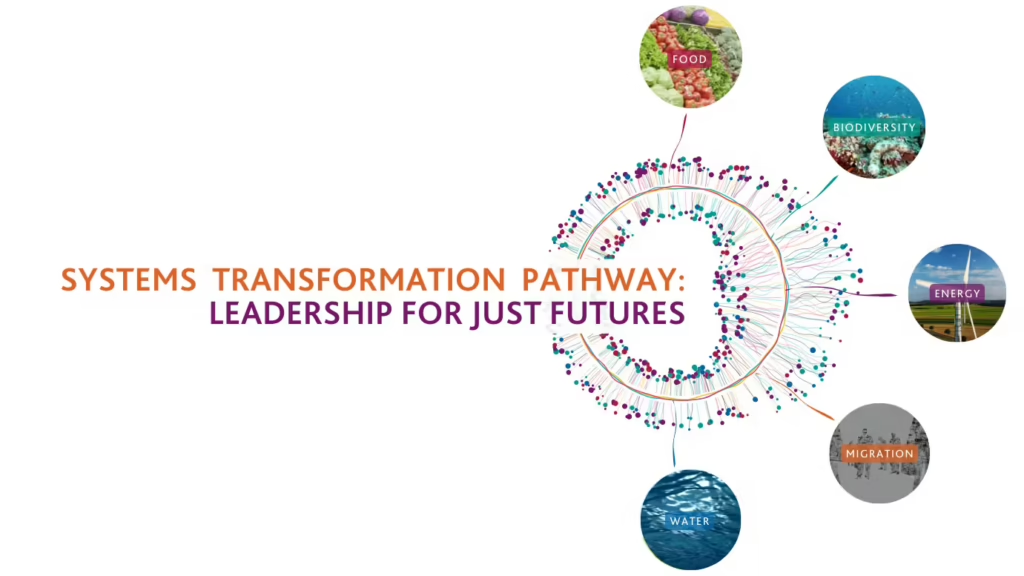
Focusing on five key impact areas: food, biodiversity, energy, migration and water, the pathway moves beyond traditional subject silos. Instead, it teaches students how environmental, economic, social and political systems interact, how climate influences migration, how governance affects resource distribution and how technology shapes identity and power. With this comes a deep emphasis on resilience, ethical leadership and agency. Students are not treated as passive learners, but as emerging systems transformers capable of engaging with the world’s challenges now, not someday in the future.
Taking the place of two Standard Level IB Diploma courses, the STP is the most substantial piece in a student’s academic programme. The first two STP cohorts have been accepted into universities across the world including Stanford, Princeton, Oxford, Cambridge and many other universities around the world.
Students who study UWC Atlantic’s Systems Transformation Pathway learn:
- Systems thinking: how to map problems, identify leverage points, anticipate unintended consequences and recognise the interconnected nature of global challenges.
- Resilience: Not resilience as endurance, but resilience as adaptability. Students learn the ability to face uncertainty without paralysis and build systems and solutions through iteration, collaboration and creativity.
- Ethical Leadership: Leadership models that prioritise justice, sustainability and compassion rather than competition and self-interest. Leadership that understands power not as dominance but as responsibility.
- Active agency: Above all, students must learn to act, to see themselves as contributors, not spectators. Traditional education often positions young people as future citizens. The Systems Transformation Pathway insists that they are citizens now.
The world our young people are stepping into is turbulent, but it is not hopeless. They are already demonstrating extraordinary commitment, bravery and imagination in movements for climate justice, human rights, equity and peace.” – Naheed Bardai
STP learning is not limited to classrooms. It unfolds in forests, workshops, community organisations, diplomatic simulations and field projects where students confront real-world systems challenges directly. Education becomes not preparation for life, but participation in it.
Our moral imperative to change
There is a growing chorus calling for transformative change in global education, yet the system itself remains stubbornly resistant. Bureaucratic inertia, outdated assessment structures and political polarisation all play a role. But we must be honest: sometimes it is simply easier to maintain the familiar than to admit that it no longer serves its purpose.
We cannot afford that comfort any longer. To continue educating young people for a world that is disappearing is a profound failure of responsibility. We are preparing them for stability while handing them instability. We are training them for linear career paths while they are entering nonlinear realities. We are teaching them to solve problems in isolation while the world demands collaborative, cross-disciplinary and globally minded thinking.
“If we want young people to inherit not just the problems of the future but the power to reshape it, then reimagining education is not optional. It is our obligation.” – Naheed Bardai
The world our young people are stepping into is turbulent, but it is not hopeless. They are already demonstrating extraordinary commitment, bravery and imagination in movements for climate justice, human rights, equity and peace. What they lack is not motivation, but institutions designed to amplify their capacity.
Education can be that institution, but only if we have the courage to transform it.
UWC Atlantic’s STP pathway is one effort among many to rethink what learning can be in a world in crisis. The conversation it sparks about systems transformation, ethical leadership and global responsibility, is one that belongs on every editorial page, in every policymaking forum, in every community.
If we want young people to inherit not just the problems of the future but the power to reshape it, then reimagining education is not optional. It is our obligation.
By Naheed Bardai

Naheed Bardai is the Principal of UWC Atlantic. You can connect with him on LinkedIn.
