
Leaders are often expected to create certainty.
They establish policies, clarify expectations, and develop plans to make what happens next more predictable. In education, where decisions affect students, educators, families, and communities, that responsibility is understandable and necessary.
But AI challenges the assumption that uncertainty can be resolved before leaders act.
As AI evolves, so do questions about assessment, privacy, professional practice, and appropriate use. Educational change has always involved uncertainty; AI makes designing for it more urgent. Earlier experiences with educational technology offer lessons in how instructional leaders can support responsible inquiry, professional judgement, and adaptation without presuming that one solution will fit every classroom.
The challenge is no longer simply to eliminate uncertainty.
We need to design for it.
The Risk of Premature Certainty
Policies, approved tools, professional learning, and clear expectations remain essential. Designing for uncertainty does not mean abandoning these safeguards.
“The risk arises when necessary decisions become permanent answers to evolving questions.” – Chris Stewart
Learning Before Knowing
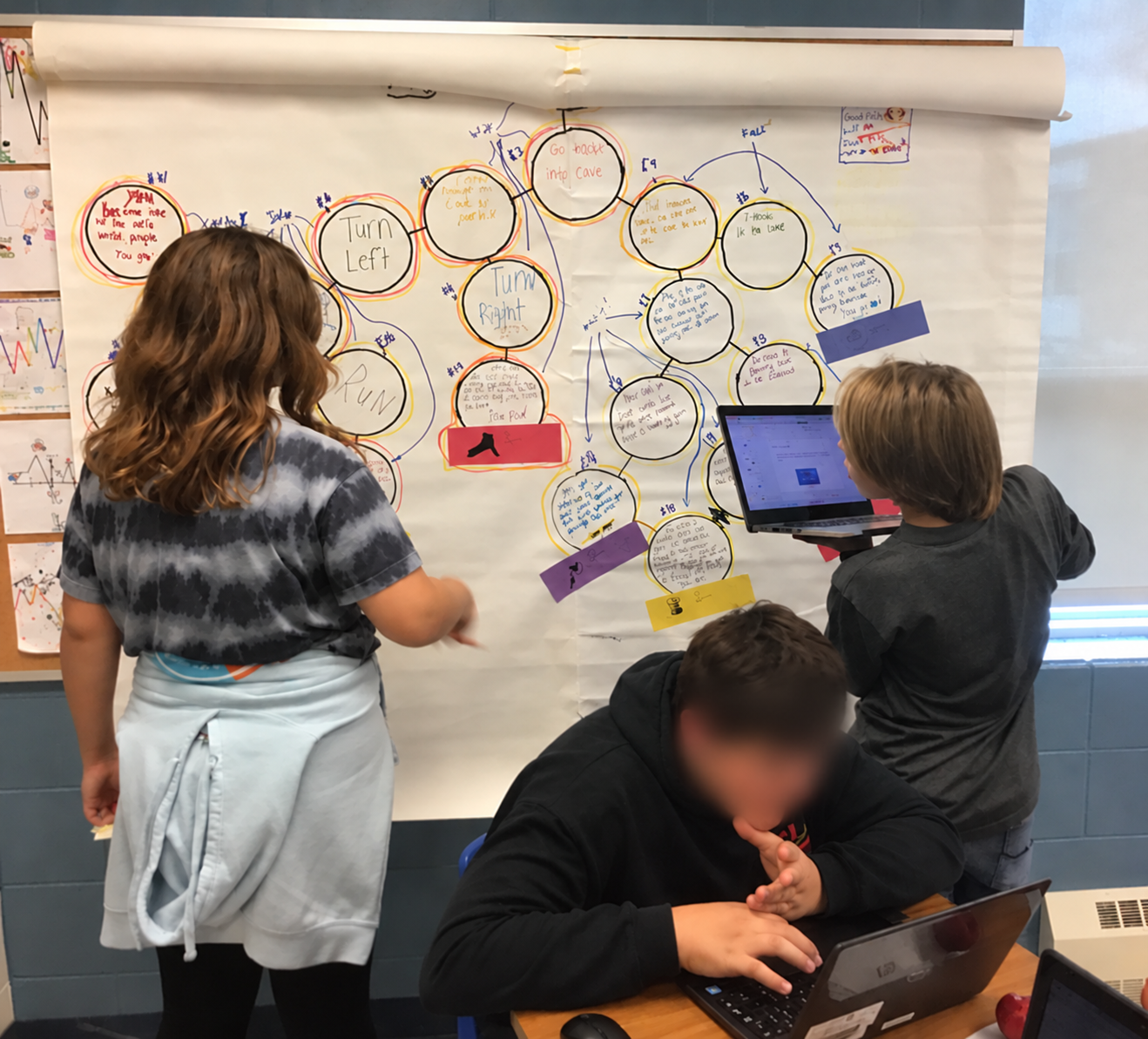
At the Catholic District School Board of Eastern Ontario (CDSBEO), I supported Blended Learning in the Intermediate Grades, a year-long inquiry into how Brightspace could strengthen student engagement, access, and different ways of demonstrating learning. We began with a clear pedagogical purpose, but not a prescribed model of effective practice for every classroom.
The inquiry proceeded with the approval and ongoing support of my supervisory officer, a superintendent of education. Principals at participating schools were invited to take part, enabling interested educators to join. As implementation progressed, ICT colleagues helped ensure access to Brightspace and needed content. Leadership established the conditions for responsible inquiry without predetermining classroom practice.
Across five schools, ten educators engaged approximately 220 students. Guided by Universal Design for Learning, teachers joined workshops, planned collaboratively, tried approaches with students, and examined what happened in classrooms. They compared experiences across schools. Evidence included teacher surveys throughout the project, classroom observations, structured reflection meetings, and student interviews at its conclusion.
Students described clearer organisation, access to materials, and helpful multimedia supports. Educators reported growing confidence and valued seeing practice enacted in classrooms. Together, their perspectives and student feedback helped identify the resources and professional learning supports needed next.
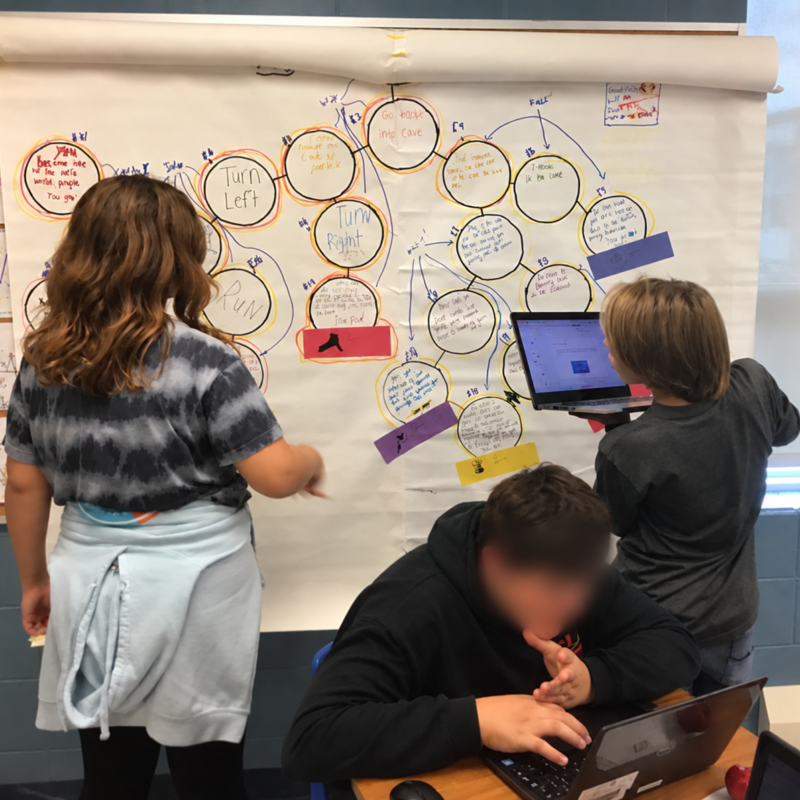 “Brightspace helped me to learn because the app organised all the subjects, and it helps me to find my work more easily.”
– Grade 7 student
“I feel like I know more than I used to. The organisation of the material and use of videos and images helped support my reading.”
– Grade 8 student
Participating teachers continue using Brightspace, and I have since observed growing interest among other staff. Although the formal inquiry concluded, it demonstrated how classroom experience can inform more responsive teaching and ongoing professional learning.
What the Experience Taught Us
- Begin with purpose, not a predetermined solution. Define the learning need while allowing practice to emerge.
- Create conditions for responsible inquiry. Secure leadership support, participation, and technical access.
- Make room to try. Authentic classroom use reveals what training alone cannot.
- Treat experience as evidence. Listen to students and educators; observe practice.
- Respect different starting points. Respond to differences in educator readiness.
- Use learning to shape what comes next. Let findings inform resources, professional learning, and decisions.
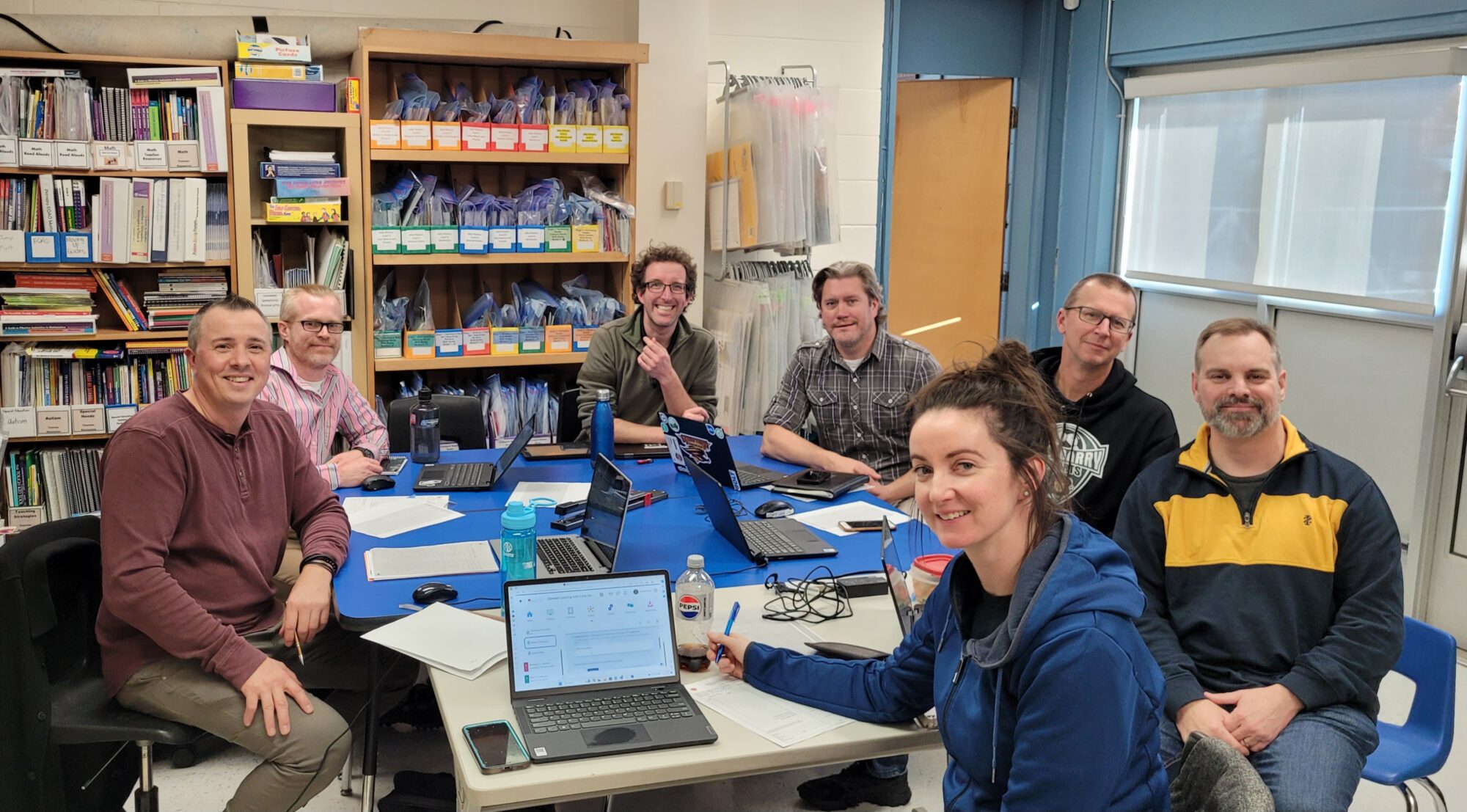
Featured left to right: CDSBEO TELT Contact—Chris Stewart and CDSBEO Educators—Andrew Sauve, Blair Fitzsimons, Mike Dickson, Marc Lajoie, Jean-Francois Major, and Meredith Clarey.
Designing for uncertainty is not indecision.
It is making responsible decisions while retaining the capacity to revisit them.
Keep Purpose Stable and Practice Adaptive
Some educational commitments should remain stable: our responsibility to students, human dignity and relationships, equity, accessibility, privacy, and meaningful learning. These provide anchors. The practices through which we honour them may need to adapt.
The same tension emerged as CDSBEO developed guidance for responsible AI use. With support from Dean Shareski at Advanced Learning Partnerships, a committee representing different organisational roles considered pedagogy, privacy, safety, equity, and organisational values. Through collective deliberation, it developed principles and guidelines approved by Executive Council. Privacy concerns shaped expectations around approved tools and student information; academic integrity discussions emphasised authentic assessment rather than AI detection.
Both experiences illustrate a central distinction:
“Leaders can provide clarity of purpose without requiring certainty of practice.” – Chris Stewart
Guidance establishes a responsible starting point. It gives educators boundaries for action while leaving room for professional judgement and further learning as new questions emerge.
Build Learning Into Implementation
Adaptability requires more than a mindset; it requires design. Rather than Decide → Implement, leaders can build a learning process:
Decide → Try → Observe → Learn → Adjust
In the Brightspace inquiry, leadership support enabled classroom experimentation, while observations and student perspectives informed subsequent support. For emerging AI guidance, approval establishes expectations without ending the need to learn and revisit decisions.
To learn collectively, people need opportunities to compare experiences, surface problems, share useful practices, and reconsider decisions. Implementation becomes a source of evidence rather than simply the execution of a plan. Decisions remain necessary, but they need not be treated as final.
“The answer to uncertainty is not better prediction alone. It is greater organisational capacity to learn.” – Chris Stewart
Professional Judgement Matters More, Not Less
No policy can anticipate every circumstance educators will encounter with AI. Principles matter because they help people understand not only what has been decided, but why. Trust is equally important: educators and leaders throughout an organisation need to question assumptions, notice emerging problems, and contribute what they are learning. Designing for uncertainty strengthens human judgement rather than replacing it with rules.
Stability Without Certainty
What transfers beyond one district or platform is a leadership approach: clarify purpose, support inquiry, gather evidence, and revisit decisions. In international schools, this might mean preserving professional learning across staff transitions or adapting practice for multinational student cohorts and differing curricula. Although approval structures vary, shared principles and reflective processes can provide continuity without requiring uniform classroom practice. The goal is not identical practice everywhere, but shared capacity to learn from different contexts.
Leaders still need to provide stability through purpose, values, relationships, and processes for learning—not by pretending to know exactly what comes next.
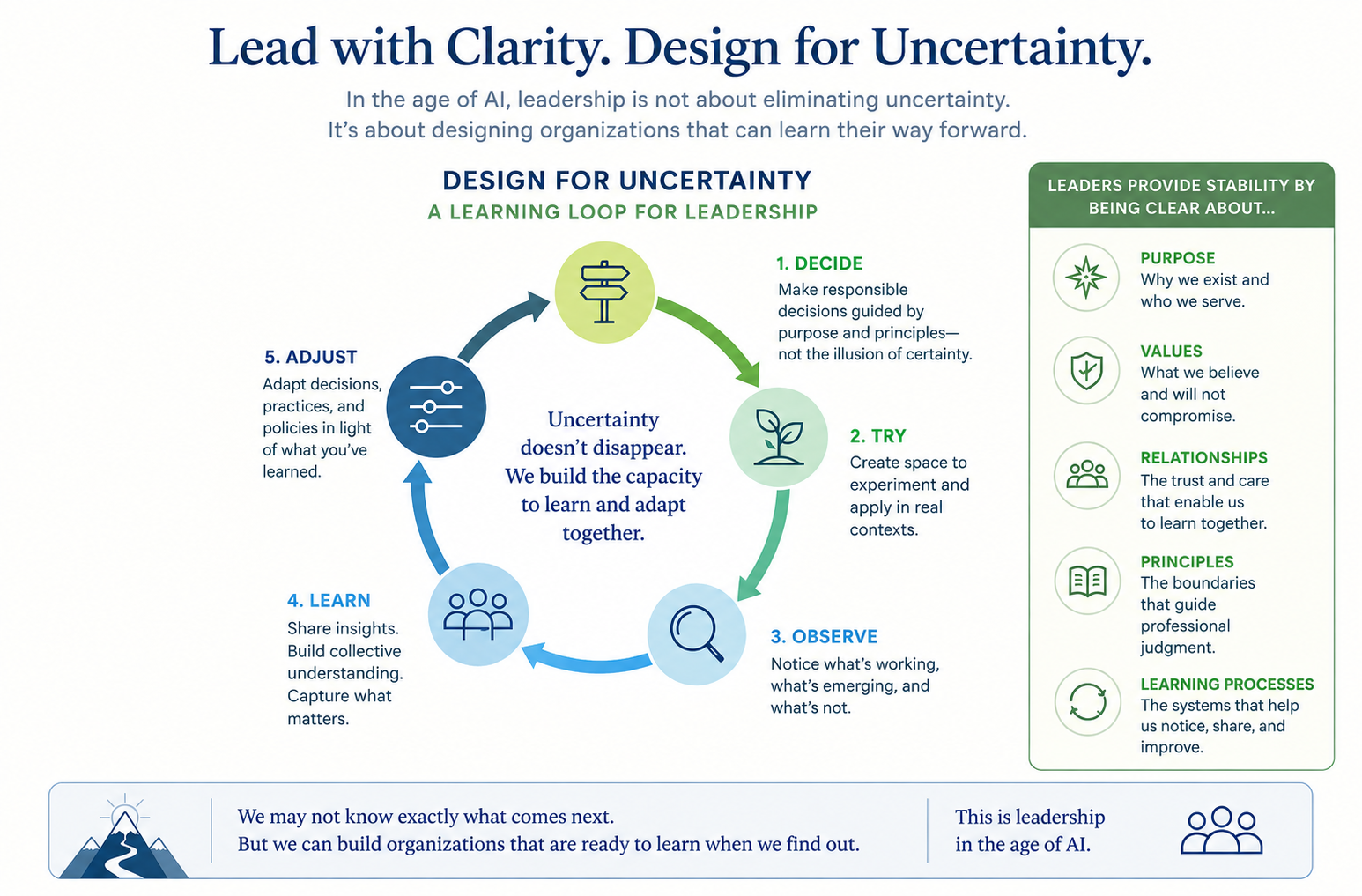
Figure: Designing for uncertainty does not mean leading without direction. Concept by the author; graphic created with assistance from ChatGPT.
Leaders provide stability through clear purpose, values, principles, relationships, and processes for learning, while creating space for practice to evolve through experience. In this way, uncertainty becomes not something an organisation must eliminate before acting, but a condition it develops the capacity to learn within.
Uncertainty does not mean an organisation is unprepared. It may be prepared precisely because it has developed the capacity to learn without knowing every answer.
Leaders do not need to predict the future perfectly to prepare their organisations for it. They can build the conditions through which people learn their way forward, together.
By Chris Stewart

Chris Stewart is a Technology-Enabled Learning and Teaching Contact with the Catholic District School Board of Eastern Ontario (CDSBEO)—an education consultant focused on instructional leadership, organisational learning, and emerging technologies. You can connect with Chris on LinkedIn or X.