

International schools offer a wonderful start to a child’s education, with the benefits of a nurturing school community, a diverse environment, and a deeper appreciation of different cultures. It’s a setting where multilingualism isn’t a barrier, it’s a superpower.
With this in mind, I was encouraged by the key takeaway from the ISC Research white paper on EAL provision in international schools. The paper recommends that international schools should frame language learning as something to celebrate, rather than a deficiency which requires specialist intervention.
I couldn’t agree more.
The report suggests that rather than viewing language learning as a problem that needs fixing, schools should integrate language development into the broader educational experience. These recommendations resonate strongly with the strategies my colleagues and I use in multilingual settings.
A Curriculum Accessible to All
Students with EAL are having to learn the difference between everyday spoken English, and the more academic form of the language which they need to access the curriculum.
This is no small task. In fact, Steve Strand OBE, Professor of Education at the University of Oxford, explains that it takes children who are new to English at least six years to become proficient in academic English. So, anything teachers can do to reduce the extra cognitive load will help multilingual children learn in a more calm and effective way.
Encountering new subjects like science and geography can be a challenge when there is specialist vocabulary to learn. It’s a good idea to pre-teach subject vocabulary – such as germination or nutrients – in advance of a lesson, adding visuals to support dual coding, so students can more easily access the lesson content later on. For example, we used Widgit Symbols to support all our pre-teaching in this way.
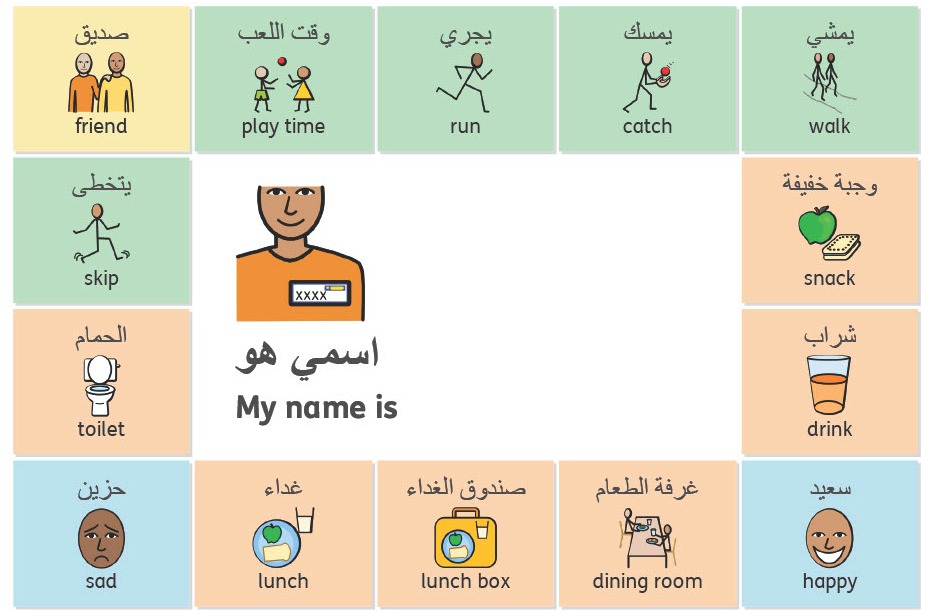
Source: Kings’ School Al Barsha, Dubai. “Arabic Buddy Scheme 2025”.
Another whole-school strategy that works well is translanguaging, which is the practice of allowing EAL learners to use their full linguistic repertoire to help them realise their potential.
Translanguaging actively encourages children to speak, write and translate to and from their first language and English, to support their learning. This deepens students’ understanding of the higher tier vocabulary they need for each subject.
“International schools are a setting where multilingualism isn’t a barrier, it’s a superpower.”
An Inclusive Environment
When a child with EAL starts at a new international school, certain aspects of school life can seem confusing, particularly if they differ from the child’s previous setting. There are also the practical challenges of following instructions, understanding routines and using equipment.
If schools can help children develop the language they need to feel comfortable in their surroundings, students will be confident and ready to learn.
One technique you can use to help younger students with day-to-day classroom vocabulary is to combine physical movement with vocabulary recall.
Orlaith O’Carroll, Inclusion Teacher at Charter Schools UAE, finds this approach effective. “If children are able to link a word with an action, they are more likely to remember that word. I have been teaching children some key classroom vocabulary, such as pencil and whiteboard, using Total Physical Response (TPR). TPR connects a word with an action, for example a teacher writing on a whiteboard or a child using a pencil. The student can help to create the actions themselves, and this serves as a powerful memory aid for them.”
Visual prompts are another great way to help children make sense of a new school environment.
Providing an illustrated representation of the day ahead can help children learn the school routines. A now/next board is ideal for young children, with a simple illustration such as a symbol to represent story time, followed by another showing outside play.
Older children benefit from a full visual timetable of school subjects, including symbols for geography or science alongside the written word.
Similarly, you can use symbols to label areas, objects and equipment such as a glue stick or stopwatch. This works best if your labelling is consistent across the whole school. It’s a simple yet effective way to help children make the connections they need to navigate the school day.
Confidence to Learn
As the ISC Research white paper suggests, it’s important to integrate language learning with the educational experience, but this can only happen if a student has the confidence to take part in classroom discussions.
To reduce anxiety, we often recommend giving children the opportunity to work with a partner and practise what they are going to say before speaking to the whole class.
Children with EAL may hesitate to ask the teacher a question because they are reluctant to speak out. While it’s important to encourage children to ask for help, it can also be reassuring for a child to refer to a visual aid so they develop the confidence to tackle a task independently.
Charlotte Goode, Assistant Head of Primary at GEMS Winchester School UAE, uses flipcharts with symbols to support Year 1 to 3 pupils with EAL. “Children can decode what a task is asking them to do without having to ask the teacher immediately. This fosters a more confident learning environment and encourages students to engage actively in their lessons.”
A Sense of Belonging
When a multilingual child is able to join in with activities and make friends, they will feel part of the school community, and this supports their learning too.
The key is to help learners with EAL develop social communication skills.
One way to get children communicating is by playing games which involve sharing information. You could try introducing activities where children have to describe objects to each other to complete a task, such as asking a partner for a certain colour or shape of a Lego piece so they can build a model together.
When children work together in small groups to create a story, it can inspire them to be creative and suggest ideas. This is most effective when using a visual prompt such as a symbol of an animal, a photo of a place, or a favourite toy.
Learners with EAL need to practise their spoken language as much as possible so they can participate fully in school life. When children hear good language role models, they are likely to emulate those skills themselves, so exercises where you pair a child with a more able English speaker can model good communication.
It’s also important to give children the opportunity to speak their first language if you can, even if it means buddying children with students in different classes or year groups. Buddies with the same first language can share ideas at a richer, more nuanced level, and explore more abstract concepts such as emotions, as well as everyday vocabulary.
As international schools take on an increasingly important role in educating the global citizens of the future, we can also lead the way in supporting multilingual students so they can find their voice and reach their full potential.
By Laura Spargo

Laura Spargo is an education consultant, primary English curriculum specialist and former Head of Primary English at Kings’ School Al Barsha, Dubai. She is also a contributor to the recently published report Unlock Understanding for Children with EAL.
